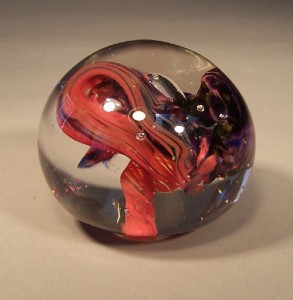
Blue and Red Swirl Paperweight

Posted in Glass | No Comments

Posted in Glass | No Comments

The paperweight class I’d signed up for at the Mesa Art Center, though cancelled three times in a row, went off fine the fourth time I registered for it, and I was able to make three paperweights. We were having trouble with the crucible kiln not clicking shut properly, and the glass got too cool, which is why they are such a hefty size (four inches in diameter).
This was my first one. Since I hadn’t done any hotshop for almost a year, I decided to make it simple and simply roll the first gather of glass in the mixed frit. Ironically, the simplest technique makes the most interesting, most complex paperweight.
Posted in Glass | No Comments

This was one of the cups I threw with my share of the batch of porcelain that some of our classmates mixed up. I had some of Kurt Weiser’s cobalt underglaze that Bridget Harper (my ceramics teacher and friend) cadged for me. I’ve done underglaze or stain on porcelain many, many times. This is a design based off of some wrapping paper I got from a stationary store years ago. I’ve done another piece with this type of design, using a sgraffito technique, but the two look very dissimilar.
Posted in pottery | No Comments

This was one of a series I made from my share of the batch of porcelain we mixed up. I tend to throw 1/4 of an inch walls on my pottery, and I’ve gotten out of the habit of trimming down to 1/8 or 1/16 of an inch walls, which is really what this porcelain wants, but this one, at least, didn’t get cracked, unlike the one with the birds on it. This design is inspired by a swatch of upholstery cloth that a friend of mine gave me a few years ago.
Posted in pottery | 2 Comments
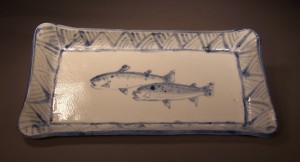
I made this using the porcelain that Bridget Harper formulated for us. One thing that I discovered about this clay is that it does not like to be thick. I made a set of twelve small trays like this (only smaller) using the same technique (slab rolled, then formed inside a styrofoam meat tray). All but three of the small trays I made got cracked and split apart in the bisque firing.
Knowing that this tray had a large likelyhood of breaking in the kiln, I decided not to spend too much time on the cobalt design. I wanted to try it out. This is Kurt Weiser’s own cobalt formula. I’ve done cobalt on porcelain so often, I daresay it’s my trademark. This worked a lot better than the plain cobalt stains that I’ve used in the past. It didn’t fade nearly as much. Of course, getting the correct amount of overglaze is, well, there’s an art to it.
Posted in pottery | No Comments